Means to monitor the occurrence of cancer in developing countries are still very limited, and prevention planning relies largely on estimates. The present paper summarises some of the priorities in cancer prevention in developing countries and the underlying evidence base, and addresses some of the challenges.
Saturday, 14 January 2012


Services and Supply Chains: The Role of the Domestic Private Sector in Water Service Delivery in Tanzania
This report presents findings from a review of the service activities of informal private water vendors in Dar es Salaam. Tanzania’s capital is a rapidly growing city, and around 70 percent of the population lacks proper housing and lives in informal settlements. Large parts of the city remain unserved by the water utility and many of those who have access to the piped network suffer from intermittent supply. As a result, small-scale private water vendors provide an essential service for many, in particular low-income households in the city.
Internal Audit Pocket Guide
This document is an abbreviated version of the Internal Audit Activity Guide for Boards of Directors of Microfinance Institutions.
The internal audit function is an independent, objective assurance and consulting activity designed to add value and improve the efficiency and security of an MFI’s operations. It helps an MFI improve its operations by bringing a systemic, disciplined approach to evaluating and improving its operations and control process. The Institute of Internal Auditors (IIA), an international professional association of more than 12,000 members, defines internal auditing as “…independent, objective assurance and consulting services designed to add value and improve an organization’s operations. It helps an organization accomplish its objectives by bringing a systematic disciplined approach to evaluate and improve the effectiveness of governance, risk management, and control processes.”
http://www.seepnetwork.org/
Best ideas of 2011: The reshaping of Capitalism
Capitalism is slowly undergoing a massive transformation - and the Best Idea of 2011 was the Reshaping of Capitalism - a call launched by Occupy Wall Street, and answered by the Social Enterprise Movement. The social enterprise revolution, which has been slowly brewing for the past three decades, has been producing a new breed of capitalists, and a generation of young social entrepreneurs that are pioneering the reshaping of capitalism in developing and developed economies across the globe. They are using private-sector models and incentives to tackle some of the world's greatest challenges in health, water, sanitation, energy and more. They have broadened their businesses models, using a more progressive definition of "profits," which include social and environmental.
Occupy Wall Street has done an incredible job of turning public attention to the faults of a global system that in its current form has become seemingly unsustainable for a prosperous society. Yet, now it is time to act. It is time to join business, not fight it, and leverage the powers of capitalism as social enterprises have, to create broader economic opportunities and social equality.
http://www.nextbillion.net/
Are you doing an MBA?
We have a complete MBA REFERENCE BOOKS PACKAGE, a collection of 1024 E-books (PDF books). The books are in the following units. Accounting & Auditing; Brand Management; Business Law; Business Plan; Business Statistics; Communication Skills; Consumer Behaviour; Corporate Culture; Cost Management; Economics; Entrepreneurship; Finance; Human Resource; Information System; Insurance; International Relations Theory; Investment Banking; Investments & Wealth Creation; Leadership; Management; Management Mathematics; Market Research; Operations Management; Operations Research; Organizational Change & Change Management; Organizational Theory; Performance Management; Project Management; Public Finance; Qualitative Research; Real Estate Finance; Risk Management; Sales & Marketing; Strategy; Supply Chain Management among others.
The package comes in 2 DVD Cost is Ksh. 3,000.
For more info Contact Francis Chege on 0721 663 208; francis@safarisoftsolutions.
100 best secondary schools in Africa
1. Grey College: South Africa
2. Rift Valley Academy: Kenya
3. King Edward VII School: South Africa
4. Hilton College: South Africa
5. St. George's College Zimbabwe
6. Prince Edward School Zimbabwe
7. International School of Kenya Kenya
8. Accra Academy Ghana
9. Lycée Lamine Guèye Senegal
10. Adisadel College Ghana
11. St John's College Houghton South Africa
12. Maritzburg College South Africa
13. Lycée Guebre Mariam Ethiopia
14. Selborne College South Africa
15. St Alban's College South Africa
16. Lycée Lyautey Morocco
17. Durban High School South Africa
18. Grey High School South Africa
19. St Andrew`s College South Africa
20. Gateway High School Zimbabwe
21. Glenwood High School South Africa
22. Rainbow International School Uganda
23. Lycée Moulay Youssef Morocco
24. Kearsney College South Africa
25. St. James High School Zimbabwe
26. Wynberg Boys High School South Africa
27. Pretoria Boys High School South Africa
28. Lycée Français de Tananarive Madagascar
29. Mauritius College of the Air Mauritius
30. International School Moshi Tanzania
31. Le Collège Mermoz Ivory Coast
32. Strathmore School Kenya
33. Parktown Boys' High School South Africa
34. International School of Tanganyika Tanzania
35. Holy Child School Ghana
36. Christ The King College Onitsha Nigeria
37. Graeme College South Africa
38. Jeppe High School for Boys South Africa
39. Alliance High School Kenya
40. Hillcrest School Jos Nigeria
41. Kingswood College South Africa
42. Hamilton High School Zimbabwe
43. Lincoln International School Uganda
44. Lycée Victor Hugo Morocco
45. Alexandra High School South Africa
46. École Normale Supérieure Guinea
47. Ghana International School Ghana
48. Arundel School Zimbabwe
49. Rondebosch Boys' High School South Africa
50. Starehe Boys' Centre Kenya
51. American International School of Johannesburg South Africa
52. Victoria Park High School South Africa
53. Methodist Boys High School Sierra Leone
54. Harare International School Zimbabwe
55. Methodist Girls High School Sierra Leone
56. Lenana School Kenya
57. St. Andrew's High School Malawi
58. Benoni High School South Africa
59. Waddilove High School Zimbabwe
60. Roedean School South Africa
61. Wykeham Collegiate Independent School for Girls South Africa
62. Lycee Francais du Caire Egypt
63. Christian Brothers' College Bulawayo Zimbabwe
64. Kamuzu Academy Malawi
65. Mount Pleasant High School Zimbabwe
66. Mfantsipim School Ghana
67. Chisipite Senior School Zimbabwe
68. Gayaza High School Uganda
69. Kutama College Zimbabwe
70. Wheelus High School Libya
71. Michaelhouse School South Africa
72. Westville Boys' High School South Africa
73. Namilyango College Uganda
74. Government College Umuahia Nigeria
75. Muir College South Africa
76. Wesley Girls High School Ghana
77. Alexander Sinton High School South Africa
78. Lycée Faidherbe Senegal
79. Royal College Port Louis Mauritius
80. Lycée La Fontaine Niger
81. Lycée Lyautey de Casablanca Morocco
82. Settlers High School South Africa
83. Nyeri High School Kenya
84. Pinetown Boys' High School South Africa
85. Kings' College Lagos Nigeria
86. Lycée Français Liberté Mali
87. Paarl Boys' High School South Africa
88. St. Paul's College Namibia
89. Tafari Makonnen School Ethiopia
90. Wynberg Girls' High School South Africa
91. Bingham Academy Ethiopia
92. Port Shepstone High School South Africa
93. Clapham High School South Africa
94. Hillcrest Secondary School Kenya
95. South African College School South Africa
96. Lycée Blaise Diagne Senegal
97. St Mary's Diocesan School for Girls South Africa
98. Townsend High School Zimbabwe
99. St.Gregory's College Nigeria
100. Allan Wilson High School Zimbabw
--
Rehema
Patriot in Kampala,East Africa
When the boot of government is on your neck,it doesn't matter if it's left or right. Today is Buganda, tomorrow is some one else. Click on both links to listen to these revolutionary songs, courtesy of UAH Forum:
http://ugandansatheart.files.
http://ugandansatheart.files.
--
UAH is devoted to matters of interest to Ugandans and Africans in general. Individuals are responsible for whatever they post on this forum.Follow UAH on Twitter at:http://twitter.com/#!/
A future for international climate politics
Political leaders are busy fighting the global financial crisis. But the lack of public interest and disengagement of relevant actors in the UN climate negotiations (UNFCCC) has – in light of the rise of the G-20 as the new and powerful global governance forum – the potential to conceal what is really at stake. Climate change gnaws at the very foundation of our societies, as it upsets the existing fragile social balance between the haves and have-nots. The poorest people, who bear little to no responsibility for the climate problem, face the most dire, even catastrophic, consequences. They are also the ones unable to cope with these consequences. Ironically, the security threat posed by climate disruption has become an important reason for climate action by the richest economies.
Hence, climate change is not simply an economic or environmental challenge requiring that the polluter pay (a practice that may be legislated in order to internalize costs for damages that were hitherto deemed externalities). Climate change in the context of a much broader crisis of ecological injustice and persistent global poverty on the one hand, and resource overconsumption on the other, is very much a moral challenge and not simply an economic and environmental one. We know the answers to this problem, and not tackling it now but delaying action into the future seems to be a characteristic feature of today’s politics.
http://www.boell.de/downloads/
Why is opening the U.S. market to poor countries so hard?
The rhetorical link between trade and development is strong, but the reality leaves something to be desired. On paper, the world’s poorest countries receive preferential access to the U.S. market; in practice, many do not. The United States is rightly praised for giving Haiti preferential access for most of its exports and for the African Growth and Opportunity Act (AGOA), which provides eligible poor countries duty-free access for everything but sugar, peanuts, and a few other products. But least developed countries (LDCs) in Asia - including Afghanistan, Bangladesh, Cambodia, Nepal, and Yemen - are effectively excluded from U.S. preference programs.
American excuses for not improving market access for all LDCs range from the impact on the Doha Round of international trade negotiations to lost jobs in the United States and Africa. These excuses, however, do not stand up to scrutiny. With the Doha Round dead if not buried, the United States has no excuse for not acting on its rhetoric and providing improved market access for all of the world’s least developed countries.
http://www.cgdev.org/files/
Donor transparency and aid allocation
The report, ‘Donor transparency and aid allocation’ is an analysis of the impact of domestic political transparency (as measured by standard corruption indices) on donor countries’ formal promotion of aid transparency. This includes not only their participation in the International Aid Transparency Initiative, but also their concrete aid allocation patterns.
It highlights that, like areas of domestic social policy, the field of foreign aid is plagued by special interest groups Aid allocation can also be used to promote the interests of specific economic sectors or to gratify politically allied governments in the developing world. If such non-development oriented motives for foreign aid gain ground, the development-oriented selectivity of aid resources will decrease. Given this framework, it is argued that the responsiveness of donor governments to special interest groups tends to increase with decreasing levels of political transparency. Consequently, the level of political transparency in a donor country should impact on both, the formal engagement to make aid more transparent and the way aid is allocated among developing countries.
http://www.die-gdi.de/CMS-
Friday, 13 January 2012
THE "NATIONAL COUNCIL" CONSULTATIVE MEETING BY SOME UPC MEMBERSWAS A HOAX

Dear Congress members,
The National Council Consultative meeting convened by the MPS, their resolutions and motion passed to remove the Party President is a total hoax/hot air and of no consequence at all. This is based on the following grounds:-
1. There are only two types of meeting of the National Council i.e An ordinary National Council meeting and an extra-Ordinary National Council meeting .The first one can only be convened by the National Chairman on the advise of the PP and the second one can only be convened by the PP in consultation with the National Chairman as per articles 12.3(2 &3) of the 2008 Constitution. Therefore the Consultative meeting that took place today at Oasis Restaurant Lugoogo does not exist in the Constitution of the Party and can only amount to aprivate meeting of Party members/leaders freely associating and discussing Party matters.Its outcome is not legally binding on the Party in anyway whatsoever.
2. The genuine National Council meeting is normally by the incumbent National Chairperson which was not the case at Lugoogo today.
3. The composition of members who attended clearly showed the majority were not members of the National Council. As someone who gate crashed the meeting, I saw a number of UPC District Chairpersons, District Councillors, LC3 Chairpersons, ordinary Party members and Youth who are not necessarily members of the National Council.
4. The UPC Parliamentary Committee has got its leader Hon:Fr Jacinto Ogwal who was absent yet everything done was done in the name of UPC Parliamentary Committee.
5. I was seriously assaulted upon arrival at the entrance by Oluka Jimmy, Asimwee Abel, Agoro Lazarus and two other Youth whose names I never got but can identify them physically. As an elected member of the Central Executive Committee, am entitled to attend such a consultative meeting convened by Party members but in the Spirit of Reconciliation, Dialogue and Forgiveness, I made it clear to the meeting that I had forgiven those five members who fought me aggressively in spite of the Police insistence that I go and record a criminal assault case against the five.
6. The motion passed is the same one used at the illegal youth Conference, therefore was more for collection of signatures which they could have even achieved without this meeting.
7. When it came to transport reimbursement, on: Obua Ogwal Benson told the members that they a big financial crisis since MOF did not give the money as they had agreed.He went on to say on seeing the Court Interim Order stopping the meeting,MOF changed its mind and refused to give the money.Consequently they reimbursed the members one way transport fair meals inclusive in the same amount.The actual given to Buganda members 5000/= ,this caused abig fight forcing the convener to increase the fair to 10,000/= (Ten Thousand)per person,Lango,Karamoja,Teso 30,000/=(Thirty thousand shillings)The majority of the party members who travelled from upcountry and attended the meeting are still stranded in Kampala. This is a repeat of what happened at the illegal and unconstitutional Youth Convention only 30th /Dec/2011.
8. We appeal to our Party members not to allow themselves to be deceived repeatedly to travel from upcountry to come for such unsanctioned meetings only to end up suffering from hunger, lack of accommodation and transport money back home.
I would like to assure our Party members that our Party President is in full control and no amount of propaganda, manipulations and deceit will derail him from leading the Party.
Thanks,
Aroma Patrick
National Leader
CAMKWOKI GRASS ROOT INITIATIVE FOR DEVELOPMENT
PO BOX 268-LIRA
TEL:+256-782-658-458
Monday, 9 January 2012
Male Organ Size: Homosexuality, Economy and Uganda’s Domestic Relations Bill
The demand by Uganda women to have a clause in the Domestic Relations Bill that allows them to divorce men with bigger organs is something interesting because it confuses one on what exactly women want. This bill has got a lot of controversial stuff in it but let me concentrate on this issue for now to see if it makes sense to people out there.
I’m afraid I look at this issue in different ways but either way, I think when people decide to get married, these are some of the things they should be ready to put up with. It will be a travesty to marriage if people start divorcing each other because either of their sexual organs has ballooned for some reason. It can only make sense if the divorce is asked when the relationship is at its early stages because there it can be argued that the person did not know exactly what they were getting themselves into, but not when the relationship has been there for a long time. People should learn to appreciate certain things about each other outside the bedroom, and I believe it is what has kept our grandfathers in marriage for ages.
Penis size and economy
Some research shows how strongly the average sizes of male organ were associated with GDPs of various countries between 1960 and 1985 according to a paper presented by Tatu Westling of the University of Helsinki in 2011. It was argued here that the average size [the erect length, to be precise] of male organ in population has a strong predictive power of economic development during the period. The exact causality can only be speculated at this point but the correlations are robust. The `male organ hypothesis’ put forward here suggests that penises carry economic significance.
Male organ was found to experience an inverted U-shaped relationship with GDP in 1985. The GDP-maximizing length was identified at around 13.5 centimeters. One striking result is the collapse in GDP after male organ exceeds the length of 16 centimeters. At that time, it was noted that countries where men have penises below 12 centimeter were less developed and these were mainly the Asian countries. Let’s leave Africa out of this argument for reasons I will explain below.
The average growth rates from 1960 to 1985 were found to be negatively correlated with the sizes of male organs: unit centimeter increase in its physical dimension was found to reduce GDP growth by 5 to 7% between 1960 and 1985. Furthermore, quite remarkable was the finding that male organ alone could explain 20% of the between-country variation in GDP growth rates between 1960 and 1985.
The physical dimension of male organ varies considerably across countries, the average being 14.5 centimeters. For example, South Korea and Zaire [now Dem. Rep. of the Congo] have average sizes of 9.66 and 17.93 centimeters, respectively according to everyoneweb.com on the link http://www.everyoneweb.com/worldpenissize/. France’s average size is 16.1 centimeters while that of UK is 13.9 centimeters. To be honest, I don’t know how these guys got all these results but the figures here are interesting.
Now Africa is still poor compared to other continents yet it is well known that men of all long and big sizes come from there. The researchers put this down to other factors other than the size of the penis, i.e. poor political governance, diseases, malnutrition and regular conflicts on the continent. But then again, may be our current leaders have got smaller penises and that is why we are in this mess. I wish there is a way we can find out about this to test this theory. May be if we all chip in and bribe the first ladies on the continent, it will make this research a bit easier. But if this argument is true, then it looks like the Americans may get out of recession soon if they stick with Barack Obama in the White House for a second term running.

Bill Frist
However, it has been found that there is no coleration between a man’s height and the length of his penis. Why many women still think “height” is more important than other physical features of males, I guess we will never know. Put height together with penis size, for example, and explain the aesthetics and beauty that some women use in mate selection. For instance, average heights did increase between 1750 and 1875 among European populations because of improvements in diets and increases in intakes of calories but this did not necessarily reflect an increase in their penis heights. Indeed the evidence that dimensions of body parts and penile lengths are correlated is mixed. Also there is no evidence to suggest that a man’s shoe size and penile length are related.
Homosexuality
A columnist in USA wrote in 2006 on website World Net Daily that use of soy products leads to reduced penis size and higher rates of male homosexuality. I guess scientists are still trying to find out why some people claim to be gay since their childhood after findings revealed in 1980s that higher testosterone levels among gay men are as often as among heterosexuals. In 1984 Heino Meyer-Bahlburg, a neurobiologist at Columbia University, analyzed the results of twenty-seven studies undertaken to test the hormone theory which used to be claimed by some people as explanation for being gay. He found that there is no difference between the testosterone or estrogen levels of homosexual and heterosexual men.
This columnist wrote that when you feed your baby soy formula, you’re giving him or her equivalent of five birth control pills a day. A baby’s endocrine system just can’t cope with that kind of massive assault, so some damage is inevitable. At the extreme, the damage can be fatal.
He also revealed that Soy is feminizing, and commonly leads to a decrease in the size of the penis, sexual confusion and homosexuality. That’s why most of the medical (not socio-spiritual) blame for today’s rise in homosexuality must fall upon the rise in soy formula and other soy products.
To carry that theory a little further, maybe penis size is the reason for gay men not having normal relationships with women; they are embarrassed by the size of their members. Therefore, those who systematically engage in anal sex have smaller than normal penises, affording their partners less damage. It is a fact that many men obsess over penis size, weaker minded males often engage in transference.
So guys, it looks like penis size does not really matter in anything depending where you are standing. I guess my Chinese friends would say: ‘Dude, the only one who has an issue about your penis size is you and the brainless ladies in Uganda. I have enough on my mind with trying to figure out how to become a superpower, calculating different responses I get from Americans by supporting dictators in Africa, and trying to fit in enough time for sleep and work, which I wish I had the luxury of time to think about what size penis you have. I really don’t have that time, so it looks like I’m out of luck.’’
Anyway, the bottom line is that this issue should be carefully looked at when writing the final piece of the Domestic Relations Bill. Think about it: a chap in Australia killed his wife after she teased him about his penis size and this is something that may cause problems for us in future if we put such issues on a paper. This is a genuine Australian case, but even as a hypothetical one, it’s interesting.
Abbey Kibirige Semuwemba
United Kingdom
Besigye-M7 Pending talks is a ”Bone-head” idea but a bit exciting
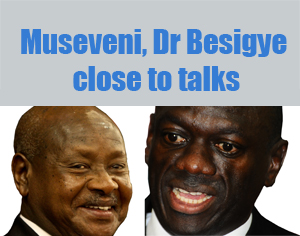
The Observer front page headline on 02/01/2012
It is also obvious that the story was intentionally leaked to the press to see the reaction from both camps: Besigye and Museveni’s, and the elites who read such stories published in English. So far, both sides have remained silent about it which confirms that something is in the pipeline. Even the big ‘mouthed’ Tamare Mirundi has not come out yet with his ‘bullets’ to shoot those ‘Nagendaising’ the situation, which shows that this is a big thing in the corridors of power in Uganda. The story has appeared both in the Newvision and Observer newspapers.
However, the whole exercise of these talks is a misdirected effort because the majority of Ugandans would be happy if president Museveni offers a quick time frame to step down from the presidency, but this is not something we expect from these talks. Museveni is not ready to give up power to anybody soon despite the recent Daily Monitor headline of ‘I will not stay in power forever’. The man has no intention at all to give up an inch of power, and I’m sure Besigye is aware of it, and we assume he (Besigye) is bothered by it .So what will be the basis of these talks, I wonder.
On the other hand, senior FDC officials are increasingly aware that there is a need to start planning for a political future after Dr.Besiggye, but do not quite know how to achieve that end. Besigye has already announced his intention to stand down from the FDC presidency despite his undoubted popularity among Ugandans. So, why involve himself in political deals he may not be there to supervise and see to it that they are fully implemented? Let’s say, for instance, Museveni agrees to a power sharing interim government, what will be Besigye’s and the new FDC president positions in the new government? Who will be the superior decision maker in the new government? This whole thing may ultimately weaken FDC if not handled properly.
Seriously, I don’t have a problem with the idea of talks between the opposition and Museveni government, and it is indeed encouraging to see that some people want it to happen, but there is a lot of water under the bridge at the moment- which makes it a bonehead idea at the moment.
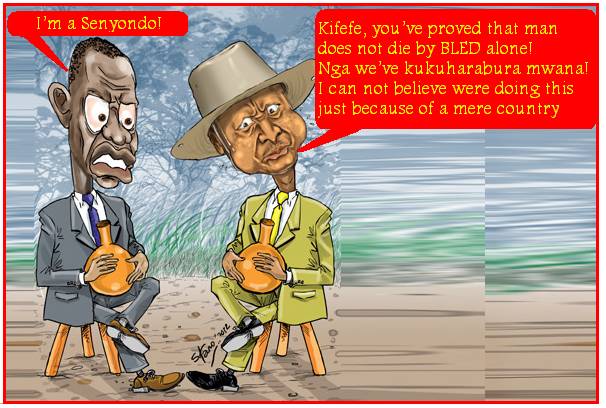
A lot of people are in prison or exile because of the fights that have been going between these two guys, and I’m wondering if they have got any stake in these talks. Will there be an unconditional amnesty granted to all those perceived to be enemies of the state? Will all political prisoners be pardoned and let back on the street to do whatever they want before or after these talks? What about other stakeholders, such as the Mengo administration and Ssubi, which formed an alliance with Besigye in 2011 elections to see that Buganda achieves its demands from the central government? Will the Kabaka be involved in these talks? What about the religious leaders who are tired of corruption in government offices and would like the government to also get tough on homosexuality? What about those who just want to see the back of president Museveni for good as soon as possible and Besigye was seen as a representation of such feelings?
That’s why I think that the idea of talks between ‘Ajja Genda’ and ‘Mpekoni’ or ‘do u want another rap’ guy makes very little sense. Yes, looking for the “good”, or looking for the “truth” both proceed by talking and also by investigation and neither, in and of themselves, result in the creation of a sustainable political climate. However, looking for good as opposed to truth is precisely what has led Sub-Saharan Africa to its present downward spiral. Instead of recognizing truths which require little study and even less talk, western governments, media and academe have consistently tried to see good at the expense of recognizing such clear and obvious truths. The damage that this has done is just as evident and all in the service of a corrupt concept of natural equality.
If, therefore, we are to have meaningful talks between the government and opposition, president Museveni must publicly state that he is going to resign from the presidency at a specific date. Short of that, we may as well say that Besigye has betrayed the people who put too much trust in him. All the truth about everything evil this government has done must be put on the table as enough reason for the president to hang his boots as soon as possible. Truth is truth and looking the other way helps no one.
Byebyo ebyange
Abbey Semuwemba
Thursday, 5 January 2012
Human Rights Watch - Against All Odds Report 2012
This 47-page report draws on six years of research, and interviews and correspondence with correctional officials and hundreds of youth offenders serving life without parole. Human Rights Watch found that nearly every youth offender serving life without parole reported physical violence or sexual abuse by other inmates or corrections officers. Nationwide statistics indicate that young prisoners serving any type of sentence in adult prison, as well as those with a slight build and low body weight, are most vulnerable to attack.
http://www.hrw.org/sites/
http://www.hrw.org/sites/
Digital Divide: From Computer Access to Online Activities
This study addresses issues of digital divide among households and individuals by using micro-data analysis of ICT usage patterns. The analysis includes data from 18 European countries, Korea and Canada. Inequalities in computer and Internet use are analyzed in a two-step approach. First, the paper tries to better quantify and understand the factors that separate the ‘haves’ and the ‘have-nots’. Second, it tries to explain observed differences in the frequency and type of Internet use as a result of the socio-economic characteristics of households and individuals.
http://www.oecd-ilibrary.org/
http://www.oecd-ilibrary.org/
Global Information Society Watch 2011
2011 has been a watershed year for the internet in creating peoples' movements worldwide for human rights and democracy. The Global Information Society Watch 2011 report by APC and Hivos looks at these stories and commentates on the future of the internet in this emerging context.
http://giswatch.org/sites/
http://giswatch.org/sites/
Regulation of Transborder Data Flows under Data Protection and Privacy Law
Despite the fundamental changes in the data processing landscape, and the growth in the regulation of transborder data flows in numerous countries, there has been little attempt so far to conduct a systematic inventory of such regulation at a global level; to examine the policies underlying it; and to consider whether those policies need to be re-evaluated. This study is designed to describe the present status of transborder data flow regulation, and to provoke reflection about its aims, operation, and effectiveness, now and in the future.
http://www.oecd-ilibrary.org/
http://www.oecd-ilibrary.org/
Subscribe to:
Posts (Atom)